
Subtotal $0.00
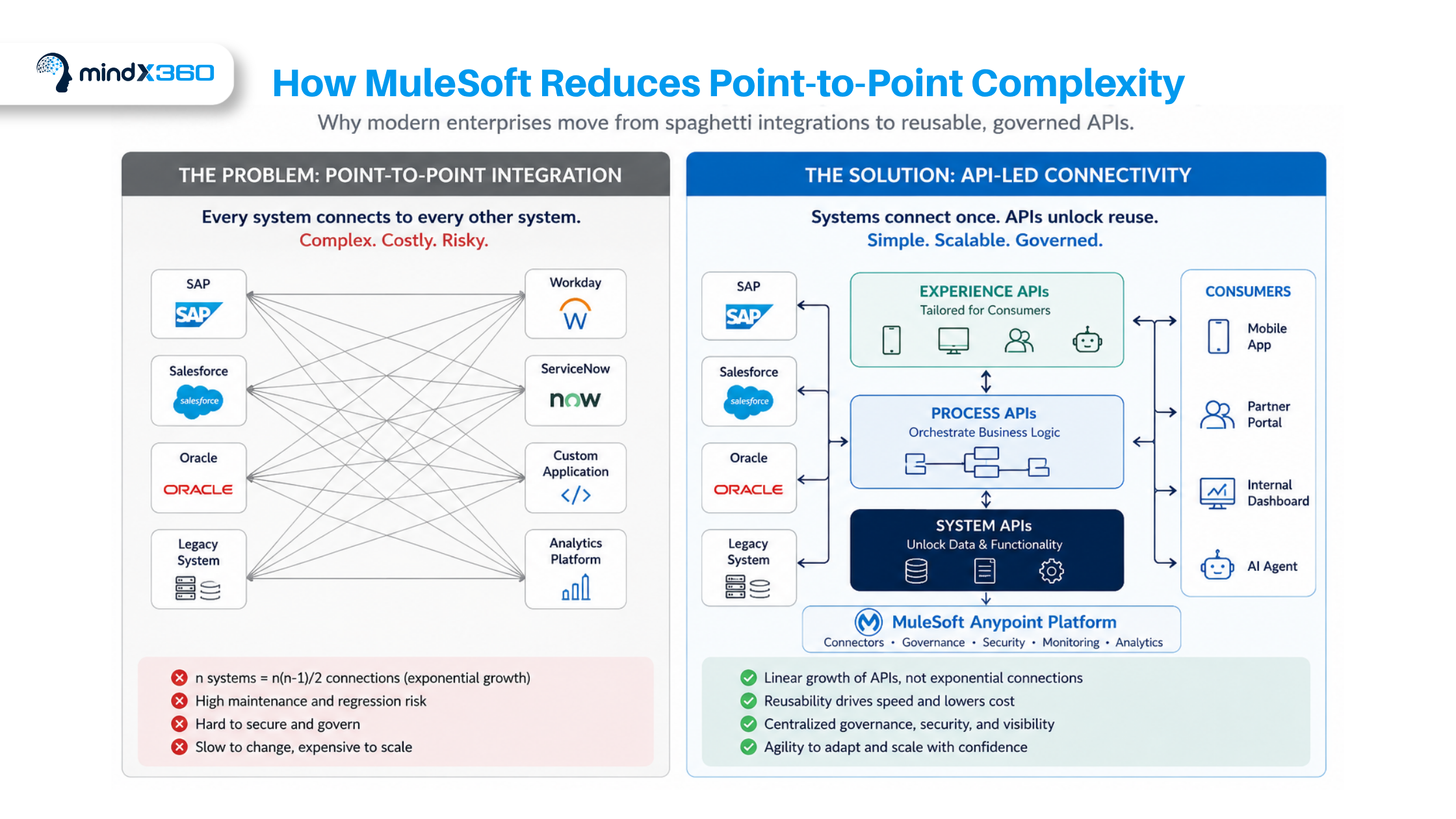
Integration programs rarely struggle because the technology was wrong. They struggle because the architecture quietly turned into a web of point-to-point connections that no one wants to touch.
It usually starts well. Two systems need to talk, so the team builds a direct integration. Then a third system joins, then a fourth. Each new connection feels reasonable in isolation. A year later, the architecture diagram looks like a plate of spaghetti, every change is a regression risk, and the integration team is the bottleneck for the entire enterprise.
This is the point-to-point trap. And it is exactly the problem MuleSoft Anypoint Platform is built to solve.
The math no one talks about
Point-to-point integration scales badly because of basic combinatorics. For n systems that need to exchange data, the maximum number of direct connections is n(n-1)/2.
– 5 systems → up to 10 connections
– 10 systems → up to 45 connections
– 20 systems → up to 190 connections
– 50 systems → up to 1,225 connections
Each connection is custom code: bespoke transformations, hardcoded endpoints, point-in-time security choices, and an owner who may have left the company. Every system change forces a regression check across every connection it touches. The cost of change rises faster than the value of new integrations.
This is why enterprises with strong delivery teams still end up with backlogs. The architecture itself is consuming their capacity.
The shift: from connections to capabilities
MuleSoft’s contribution is not just middleware. It is a reframing of how integration is designed and consumed, expressed through API-led connectivity
The model organises APIs into three purposeful layers:
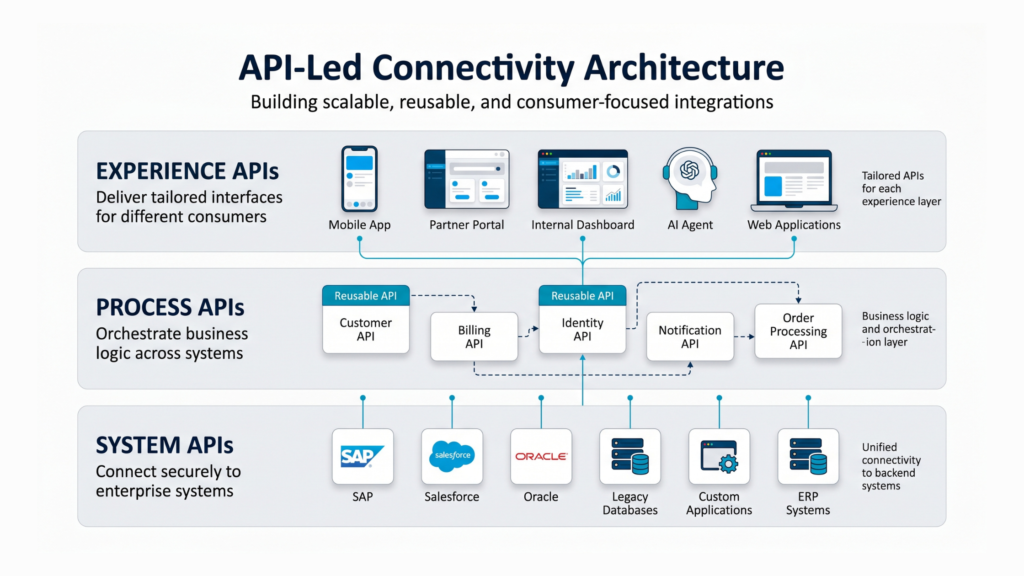
1. System APIs unlock data and functions from underlying systems — SAP, Salesforce, Oracle, legacy databases, custom apps. They are the only layer that talks directly to source systems, which means each source system is now connected to one thing, not many.
2. Process APIs orchestrate business logic across multiple System APIs. For example, “create customer” might combine identity, CRM, billing, and notification flows. Process APIs hold the rules; they do not hold the system details.
3. Experience APIs package data and processes for specific consumers — mobile app, partner portal, internal dashboard, AI agent. Each consumer gets a tailored interface without forcing changes downstream.
The architectural effect is decoupling. Source systems change without breaking consumers. Consumers change without renegotiating with source systems. Process logic lives in one place. The N² growth of connections is replaced by linear growth of well-defined APIs.
Reuse is where the economics flip
The point-to-point world has no reuse. Every integration is a new project.
MuleSoft’s Anypoint Exchange flips this: published APIs become discoverable, governed assets that future projects compose rather than rebuild. MuleSoft’s annual Connectivity Benchmark Report has consistently shown that organisations with mature API reuse practices deliver projects faster and spend less on integration per outcome.
The mechanism is simple. The second project that needs a customer API does not pay to build one. The tenth project pays nothing at all. Productivity compounds.
This is how integration becomes a platform capability instead of a per-project tax.
What MuleSoft adds on top of the model
The API-led approach is the architecture. Anypoint Platform is the operating environment that makes it sustainable at enterprise scale:
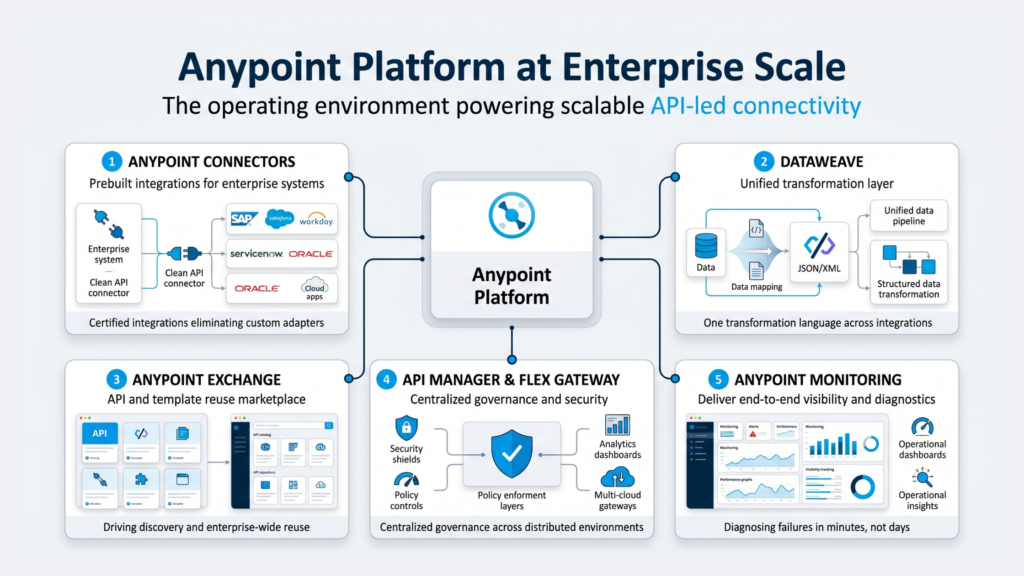
Anypoint Connectors — prebuilt, certified integrations for SAP, Salesforce, Workday, ServiceNow, Oracle, and several hundred other systems, removing the need for custom adapters.
DataWeave — a single transformation language across all integrations, replacing the patchwork of mapping tools and custom scripts.
Anypoint Exchange — the internal marketplace for APIs, templates, and connectors that drives discovery and reuse.
Anypoint API Manager and Flex Gateway — centralized policy, security, rate limiting, and analytics, including across distributed and multi-cloud deployments.
Anypoint Monitoring — end-to-end visibility, so failures are diagnosed in minutes, not days.
Each capability directly attacks a failure mode of point-to-point integration: hidden dependencies, inconsistent security, invisible failures, and unrepeatable work.
Agentic sprawl is the next point-to-point trap
The same pattern is now emerging in enterprise AI — this time with autonomous agents.
Every business unit is experimenting with its own agent: a sales agent here, a service agent there, a knowledge agent in operations. Most are being built in isolation, wired directly to a handful of source systems, with tailored prompts, ungoverned tool calls, and no shared definition of what “customer” or “order” actually means. It is point-to-point integration with a new face only now the connections are between agents, models, and the systems they reach into.
If this goes unmanaged, the next architecture diagram will not just have spaghetti at the integration layer. It will have spaghetti at the reasoning layer as well, with the same downstream effects: duplicated effort, inconsistent behaviour, invisible failures, and serious questions around security and data exposure.
Agents are best understood as a new class of enterprise asset. They consume APIs, hold reasoning logic, and act on behalf of users and processes. Like APIs, their value compounds only when they are governed, discoverable, and reusable and only when they call into managed process and experience APIs rather than reaching directly into source systems.
This is the gap MuleSoft has moved to close. Anypoint Agent Fabric and native MCP (Model Context Protocol) support extend the API-led model to agents themselves: agents become catalogued assets in Anypoint Exchange, their tool calls are governed through API Manager, and their behavior is observable through Anypoint Monitoring. The same three-layer discipline applies agents consume Experience and Process APIs, not raw systems which means the agent layer inherits, rather than re-invents, the governance work already done.
The architectural lesson is the same as before: the second AI use case that needs a “customer agent” should not rebuild one. By the tenth use case, it should be a trusted, reusable enterprise asset.
The architectural takeaway
Reducing point-to-point complexity is not about replacing one type of connection with another. It is about changing what a connection is from a brittle, project-owned piece of code to a governed, reusable, observable capability. That principle applies just as cleanly to APIs as it does to agents. API-led connectivity not only reduces integration complexity; it provides the governed foundation that enterprise AI needs to scale safely.
That shift is what allows integration and now intelligence to keep up with the pace of business. It is also what allows IT leaders to talk about both as enablers of speed, not sources of risk.
If your team is already feeling the gravity of legacy point-to-point connections or starting to see early signs of agentic sprawl, the right time to address it is before the next ten systems or the next ten agents are added.
What does your current landscape look like a clean API-led architecture with agents treated as governed assets, or a growing web of direct connections and one-off agents? I’d be interested to hear how others are approaching the shift.
