
Subtotal $0.00
For years, enterprises have focused on digitizing documents.
Invoices were scanned. Contracts were stored electronically. Forms moved online. Optical Character Recognition reduced some manual data entry. More recently, Intelligent Document Processing has made it possible to extract and structure information from increasingly complex, unstructured documents.
That is important progress.
But it still addresses only part of the problem.
A document rarely exists in isolation. It usually represents the beginning, middle, or end of a business process.
An invoice may need to be validated against a purchase order, routed for approval, posted to an ERP system and monitored for an exception.
A contract may need clauses reviewed, obligations identified, approvals obtained and renewal dates monitored.
A service request may contain information that needs to be interpreted before records are updated, policies checked and downstream teams engaged.
The real question is therefore no longer:
“Can AI read this document?”
It is:
“Once the information is understood, can the enterprise act on it intelligently, securely and at scale?”
The document was never the real bottleneck
Traditional document automation focused heavily on converting unstructured information into data.
That made sense when the largest challenge was extracting information reliably.
Today, Intelligent Document Processing can go considerably further. MuleSoft IDP, for example, can process unstructured and semi-structured documents, use AI capabilities to analyse extracted content and return structured responses that can then be integrated into downstream applications and processes.
But structured data alone does not complete a business process.
Once information has been extracted, enterprises still need to answer questions such as:
- What does this information mean in the context of the process?
- Which business rule applies?
- Which system should be updated?
- Does another source need to be consulted?
- Should an approval be initiated?
- Which agent, API or application should perform the next action?
- And what happens when the normal path cannot continue?
This is where the conversation moves beyond document processing and into enterprise orchestration.
From extraction to context
The first generation of document automation was largely about recognition.
The next generation is about understanding.
An invoice is not simply a collection of fields. Its meaning depends on supplier information, purchase orders, contractual terms, payment policies and business rules.
A contract is not simply text. Its significance depends on clauses, obligations, risk thresholds, approval policies and the systems in which those obligations must eventually be tracked.
This distinction matters because enterprises do not create value merely by extracting a field correctly.
Value appears when that information is placed into the right business context and used to move work forward.
That requires a progression:
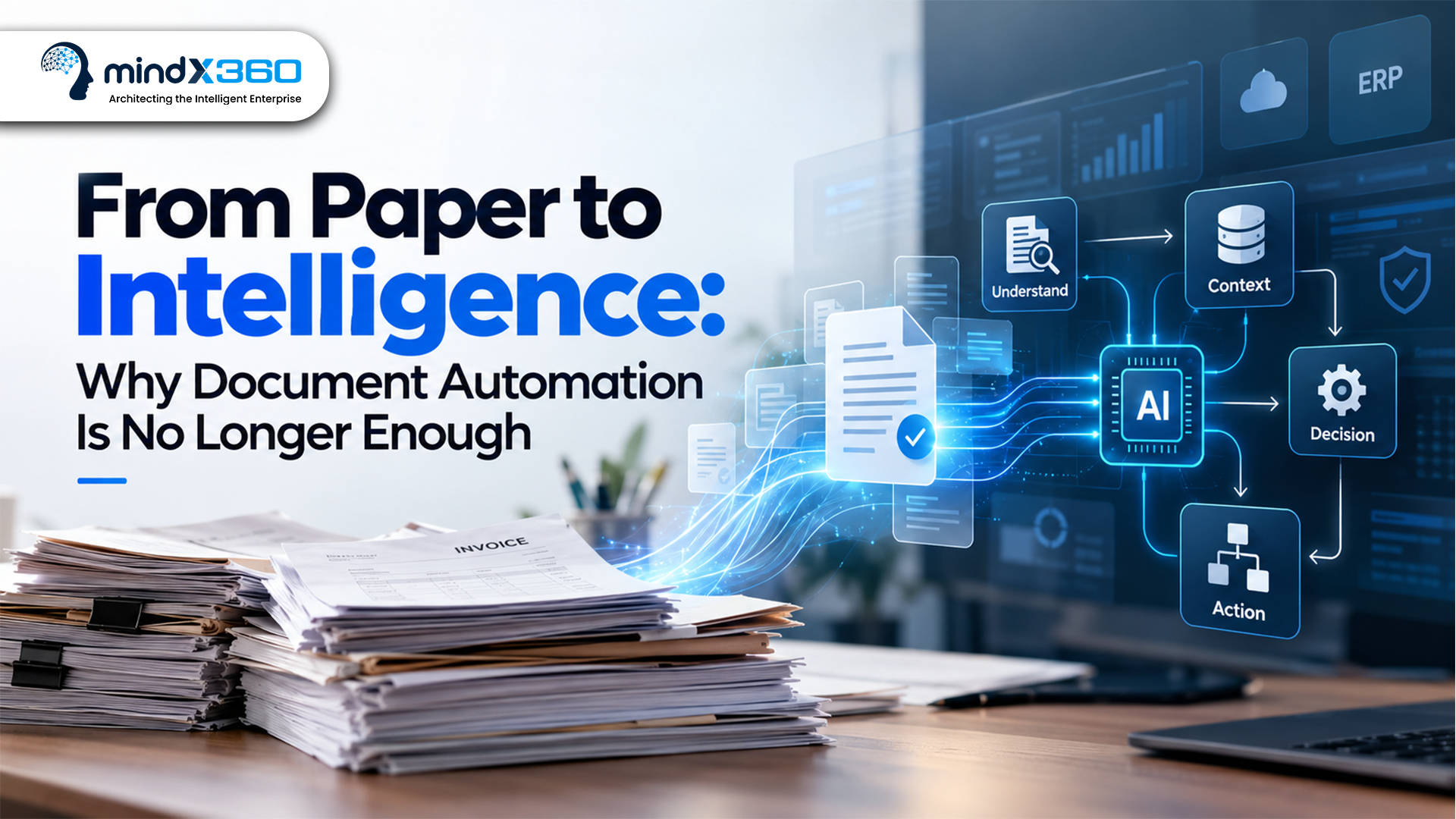
Content → Context → Decision → Action
And increasingly, enterprises are beginning to use AI agents as part of that progression.
The next challenge: orchestrating agents, tools and systems
As organizations introduce AI agents, another challenge quickly appears.
There may be one agent built on one platform, another built by a different business unit, multiple APIs, MCP servers, enterprise applications and existing automation components.
Individually, each may work.
Collectively, however, enterprises need to answer a much harder question:
How do all of these components work together without creating another layer of fragmentation?
This is where an orchestration and governance layer becomes important.
MuleSoft positions Agent Fabric as an AI control plane for agents, MCP servers and APIs across platforms, with capabilities around discovery, governance, orchestration, security and observability. It can also make existing applications, APIs and agents available as tools so that agents can take governed action across an organisation’s technology landscape.
That shifts the architecture from:
AI understands something
to:
AI agents interpret the context → Agent Fabric coordinates the right agents and tools → enterprise systems are engaged through governed connections → actions are executed and monitored.
That is a fundamentally different operating model.
Why this matters more than another AI assistant?
Many organizations are already experimenting with copilots, chat interfaces and generative AI assistants.
These tools can be extremely useful for summarizing information, retrieving knowledge and helping users reason about content.
But enterprise processes usually require something more.
They require execution.
A useful enterprise AI interaction might need to read information from one source, query another system, evaluate a rule, call an API, invoke another specialist agent, update a record and then notify the relevant stakeholder.
The value therefore does not come only from the intelligence of one model.
It comes from the coordination of intelligence with enterprise capabilities.
This is also why integration becomes more important in an agentic enterprise, not less.
The more capable AI becomes, the more important it is to provide controlled access to systems, trusted APIs, business context and governed actions.
Governance cannot be added at the end
There is another important distinction between an AI demonstration and an enterprise operating model.
A demonstration asks:
Can the agent do it?
An enterprise asks:
Should the agent be allowed to do it, under what conditions, using which identity, with which policies, and with what level of traceability?
As agent ecosystems expand, governance becomes part of the architecture itself.
MuleSoft’s Agent Fabric documentation describes capabilities for applying authentication, access and security policies across agents, MCP servers and LLM interactions, while also providing visibility into agentic assets and interactions.
That matters because as organizations deploy growing numbers of agents across teams and platforms built by different teams and platforms.
Without governance, enterprises risk replacing application silos with agent silos.
The opportunity is horizontal, not departmental.
It is tempting to think of document intelligence as belonging to one department.
In reality, the pattern is horizontal.
In procurement, it may begin with purchase orders, supplier documentation and invoices.
In finance, it may involve claims, reconciliations, financial documents and controls.
In legal, it may involve contracts, clauses, obligations and approvals.
In customer service, it may involve correspondence, attachments, case information and knowledge.
In operations, it may involve work orders, reports, certificates or compliance documentation.
The input changes.
The systems change.
The business rules change.
But the underlying pattern remains remarkably consistent:
- Understand the information.
- Add business context.
- Coordinate the right capabilities.
- Take controlled action.
That is why organizations should increasingly think beyond individual document automation projects and instead look at the reusable operating model behind them.
The real shift: from automating documents to redesigning work
The most interesting question for enterprises today is not whether AI can extract information from a PDF.
It can.
The more important question is what happens next.
- Can information move across systems without repeated manual handoffs?
- Can specialized agents collaborate rather than operate independently?
- Can existing APIs and applications become reusable tools for AI?
- Can policies and controls be enforced consistently as interactions move across agents, APIs and systems?
- Can exceptions be routed intelligently?
- Can humans stay involved where judgement or approval is genuinely required, rather than acting as the integration layer for every step?
This is the next stage of enterprise automation.
Not simply smarter documents.
Not simply more AI assistants.
But intelligent, governed orchestration across the business process.
The organizations that benefit most from agentic AI may therefore be the ones that stop asking:
“Where can we add AI?”
and start asking:
“Which business processes can we redesign now that information, intelligence, agents and enterprise systems can work together?”
That is where the conversation moves from automation to transformation.
To explore this shift further, join mindX360 and MuleSoft for :
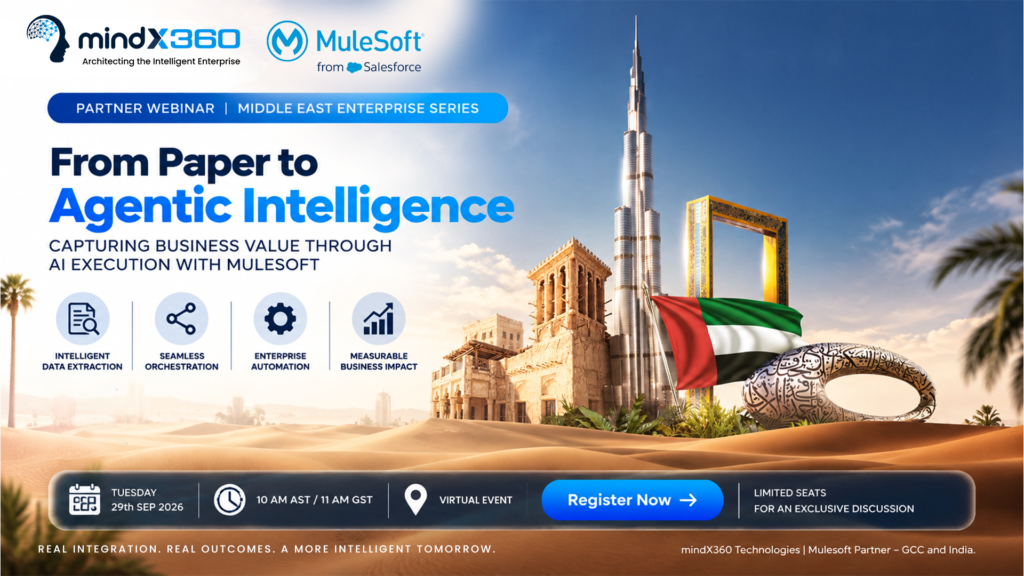
From Paper to Agentic Intelligence
Capturing Business Value Through AI Execution with MuleSoft
29 September 2026 | 10 AM AST / 11 AM GST | 12.30 PM IST Live Virtual Webinar
We’ll explore how MuleSoft IDP,Agent Fabric and enterprise integration can help organizations move from manual document processing to intelligent, governed business workflows across HR, Finance, Procurement, Legal and Service.
Ready to explore what’s possible?