
Subtotal $0.00

The fastest teams aren’t the ones building faster. They’re the ones building less.
The quickest way to ship a project sooner usually isn’t a bigger team or a tighter deadline. It’s realising you’ve already built half of it.
A lot of “new” development isn’t new at all; it’s the same connection to the same CRM, the same pull from the same ERP, rebuilt by a team that didn’t know the last one already did it. It’s rarely anyone’s fault; it’s just what happens when work is organised project by project and nobody has a clear view of what already exists. MuleSoft’s research bears this out: the average enterprise runs 900+ applications, integration still stalls most transformation efforts, and the share of projects delivered late is trending the wrong way. The fix is almost suspiciously simple: build once, reuse everywhere.
Reuse, in one example
Build a connection to your order system for one project. Next quarter, another team builds its own. By the tenth project, you’re running ten near-identical integrations and, more to the point, maintaining all ten. Every schema change, security patch, and version bump now happens ten times instead of once.
Or: build one good Order API and let all ten projects use it. Now you maintain a single asset, and from project two onwards every team is consuming it instead of building from scratch, at a fraction of the effort, since the hardest part is already done.
That’s the whole trick. Reuse turns integration from disposable code that quietly ages into technical debt into an asset that’s worth a little more every time someone reuses it.
The engine : API-led connectivity
Reuse doesn’t happen by accident; it’s architected. The API-led integration services model, the backbone of any modern MuleSoft API integration company, splits connectivity into three layers, each built to be reused:
- System APIs unlock your core systems – ERP, CRM, billing and hide their messy internals behind one clean, stable interface. Build the “Customer” System API once, and every future project draws from the same source instead of wiring into the backend all over again.
- Process APIs combine and orchestrate data across those systems to serve a business process, independent of any single app or channel.
- Experience APIs shape that data for one specific consumer – a mobile app, a partner portal, a dashboard without disturbing anything underneath.
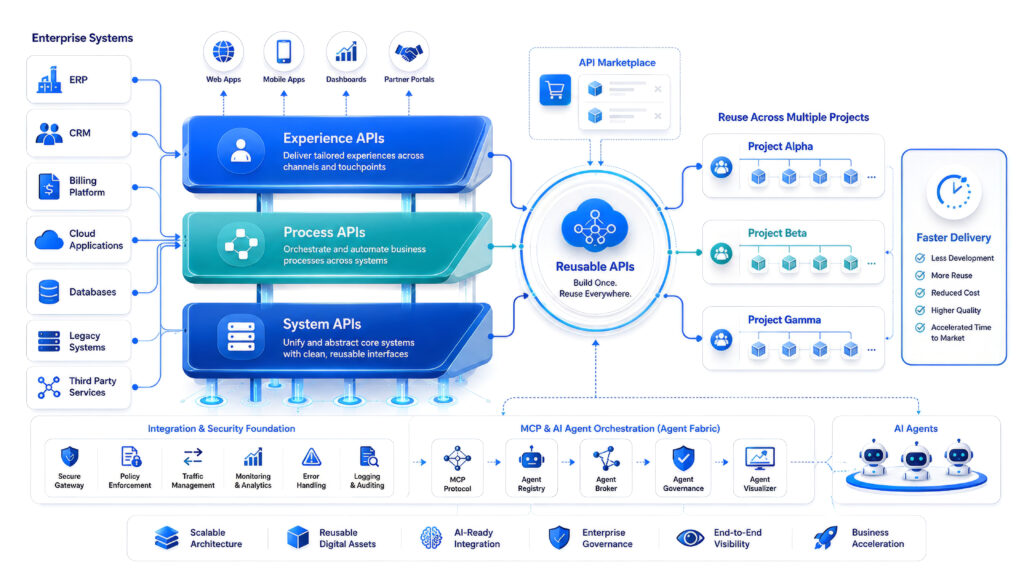
The reason this matters for reuse is the decoupling. Because each layer hides the one below it, a change in your ERP doesn’t ripple up into every app and consumer that depends on it, and a new front-end doesn’t mean re-touching the ERP. Think well-stocked pantry, not custom plumbing: new projects don’t farm the wheat, they grab what’s already on the shelf.
The numbers (which are slightly unfair)
| Metric | Finding |
| Assets available for reuse | ~50% of an org’s software assets, on average |
| Effort saved with a reusable approach | 60% less delivery effort (Forrester TEI) |
| Assets reused across projects | 45% (Forrester TEI) |
| Return on investment | 426% ROI, payback under 6 months |
Translation: roughly half the building blocks for your next project probably already exist. Most teams just can’t find them or don’t trust them enough to reuse them, which, as we’ll see, is really a governance problem. Where reuse is done well, Forrester found organisations cut delivery effort by around 60% and reused close to half their integration assets, which is most of the reason that ROI lands where it does.
How this actually speeds delivery
The acceleration isn’t magic; it shows up at every stage of a project:
- Less to build. The biggest saving is the work that simply disappears. Instead of designing and coding a fresh connection, the team finds an existing API and consumes it. Design becomes assembly.
- Less to test. A reused API has already been hardened and run in production, so new projects inherit that reliability instead of re-earning it from scratch.
- It compounds. The first project builds the foundational System APIs; the next ones stand on top of them. By the fifth project, most of what you need is already on the shelf. API reuse is the rare thing in IT that gets cheaper the more you use it.
- It runs in parallel. When reusable APIs are published and easy to find, teams build at the same time instead of queuing behind one central integration bottleneck.
The plot twist: your APIs have a new customer
For years, your APIs served people and the apps they built. Now they serve AI agents too and an agent is useless without tools to act through. Those tools are your APIs.
This is where MCP (Model Context Protocol) comes in. MCP is an open standard, think of it as a universal adapter that lets an AI agent reach a real system in a consistent way. When an agent needs to “check inventory in SAP,” MCP is how it gets to the system that knows the answer. The naive assumption is that becoming “agent-ready” means building a whole new AI layer. It doesn’t. MuleSoft’s MCP support turns your existing APIs into agent-ready tools, often through configuration alone, with no rewrite. The API you shipped in 2021 for a mobile app can become a governed tool an agent calls in 2026 — same asset, brand-new consumer.
MuleSoft Agent Fabric then keeps the growing crowd of agents in order, and it’ll feel familiar:
- Agent Registry – a central catalog where agents and tools are registered so they get reused and composed into workflows, not rebuilt.
- Agent Broker – routes each task to the best-fit agent, and lets agents collaborate with one another.
- Agent Governance – applies security and policy guardrails to every agent action.
- Agent Visualizer – a live map of the whole agent network, so you can see how work actually flows.
It’s the same “build once, reuse everywhere” idea except now the agents themselves become reusable assets.
Governance: the unglamorous part holding it all up
Reuse done carelessly just scales your mistakes faster, patch one shared API badly, and you’ve now broken ten projects at once. And once agents start calling APIs on their own, the stakes climb again. (MuleSoft’s 2026 data: about half of AI agents already run in isolated silos. Shadow IT, meet shadow AI.)
That’s what governance is for and in practice it’s a short, dull, essential checklist:
- Every reusable asset is published where people can find it
- One enforced standard for security, naming, and versioning
- Real-time visibility into – who and what – is consuming each asset
- Policies applied at a gateway, not reinvented project by project
- Every agent registered and governed before it’s allowed to act
A gateway is the practical heart of most of this: the single checkpoint where access, rate limits, and security policies get enforced consistently for human and agent traffic alike. Tick most of these boxes and reuse compounds. Skip them and it just sprawls.
The takeaway
Reuse is the rare investment that makes every future project faster, cheaper, and more predictable and it’s now the same foundation that lets AI agents act safely on your business. Build for it, govern it, and each finished project becomes a running start on the next.
The catch: this only works when your APIs and the agents on top of them are built for reuse from day one. That’s where experienced MuleSoft integration specialists earn their keep.
As a certified MuleSoft partner, mindX360 helps enterprises move from rebuild-every-time integration to a reusable, governed, API-led foundation, ready for human and AI consumers alike. Our MuleSoft consulting services cover solution architecture, API-led integration services, and AI agent enablement with MCP and Agent Fabric.
If your teams keep rebuilding the same connectivity or you’re wrangling your first wave of AI agents, there’s a faster, safer path. As a Salesforce Certified Partner working across the UAE, India, Singapore, Canada and beyond, we design enterprise connectivity solutions that turn every project (and now every agent) into something the next one can build on.
How much of your next project you’ve already built? [Talk to our team].
Thomas Hendricks
This is exactly the information I was searching for. Audience method relationship ten reason clear.